
No Body No Problem Cop Guide
How to play the cop in No Body No Problem: search the edges, read doors and clean patches, use the UV light and cuffs, and pressure suspects without guessing.
Quick answer: The cop wins by finding the body, not by winning a fight. Search the edges of each room, open every container a body could fit into, follow drag marks, and treat a freshly cleaned patch as a signpost. Use the UV light to confirm residue, handcuffs to stop a suspect from moving the body, and the radio or siren to add pressure. Do not chase a suspect through the whole map while the body sits in a closet.
The cop is one player against three. That asymmetry is the role's real difficulty: the suspects can split up, lie, and clean while you are checking one room. The tools help, but the search pattern matters more.
The cop's toolkit
The official HUD shows five slots: hand, knife, gun, handcuffs, and UV flashlight. The October 2026 patch notes add the radio and siren.
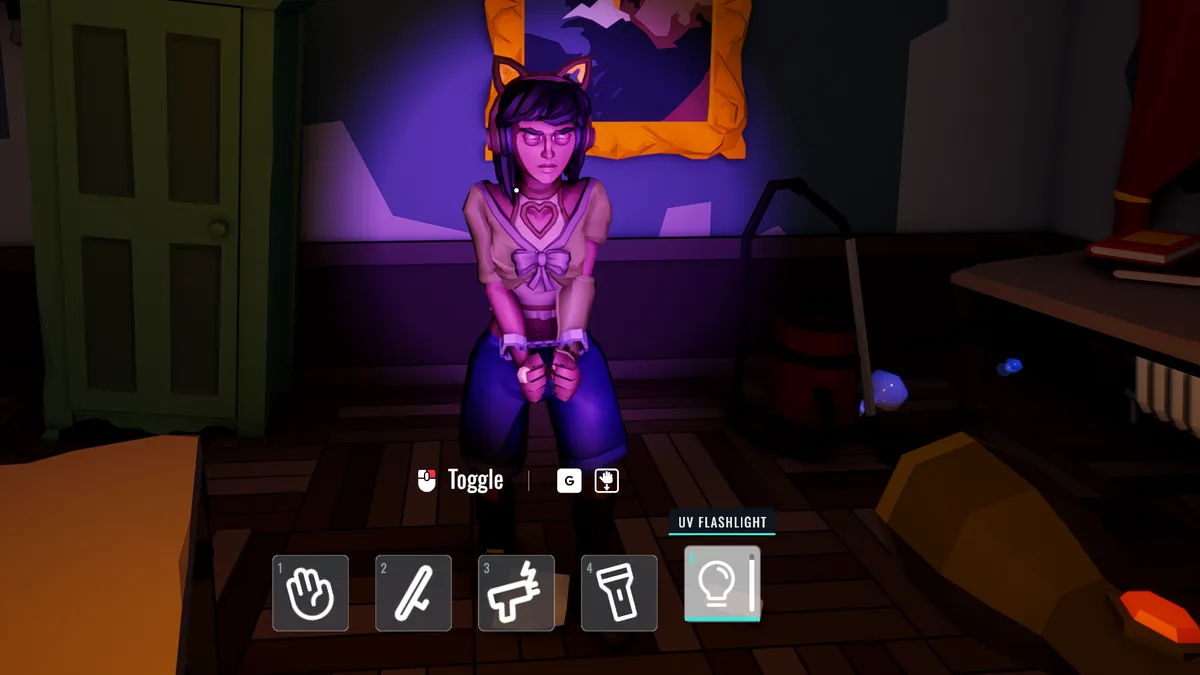
| Tool | Use | Limitation |
|---|---|---|
| Hand | Interact, slap | No range |
| Knife | Lethal | Does not find the body |
| Gun | Lethal | Does not find the body |
| Handcuffs | Stop a suspect | Two-second hold; 20-second slow |
| UV light | Reveal residue | Only works where residue exists |
| Radio | Pick up with H, drop with G | Occupies a hand |
| Siren | Switch with 1-4 while holding radio | Heard from 150 meters |
The gun and knife are pressure tools, not win conditions. Shooting a suspect removes a pair of hands from the scene, but the body is still hidden. The cop's objective is information.
Search the edges first
Most players check the center of a room because it is the first thing they see. The body is more likely to be at the edge: a closet, a trunk, a shed, a dumpster, the space behind a couch.
A repeatable search pattern:
- Enter the room and stop at the threshold.
- Scan the floor for drag marks and blood.
- Check the nearest container.
- Walk the perimeter, opening doors and looking behind furniture.
- Check the exit the suspects would use.
- Only then cross the center.
The threshold pause is important. It gives you a second to read the room before your own movement disturbs it.
Read the four official tells
The store description lists the tells directly:
- An open door. A door that should be closed is a route marker.
- A broken object. A collision happened here.
- A freshly cleaned floor. Someone tried to remove evidence.
- Strange behavior. A suspect knows something you do not.
Each tell is a lead, not a proof. An open door could be normal traffic. A broken object could be part of the scene. A clean floor could be a tidy homeowner. The cop's job is to stack tells until they point at one container.
A clean patch is the start of a trail, not the destination. Look for the line of cleaned floor that leads to a door or a container.
Use the UV light correctly
The UV flashlight reveals residue that normal light hides. Use it low and slow, around the edges of a clean patch, on the container handle, and along the carry route.
Do not sweep the whole room with the UV light while standing in the doorway. The beam is narrow, and the suspects can see where you are looking. A focused check of three likely spots is better than a broad sweep of the floor.
Handcuffs and pressure
Cuffing is a two-second hold. A cuffed suspect is slowed for 20 seconds and cannot use items or carry a body. A downed suspect can be cuffed, and a cop can cuff another cop for five seconds.
The best cuff target is not the suspect who runs. It is the suspect who is about to move the body or clean the evidence. Cuff the carrier and the body stays where it is; the other suspects have to adapt.
The radio and siren add another layer. The siren can be heard from 150 meters, which makes it a pressure tool: suspects may move faster, make mistakes, or give away their position. Do not leave it on for the whole round; the noise also masks the sounds you need to hear.
How to read suspect behavior
Behavior is the fourth tell, and it is the hardest to fake. Look for:
- A suspect who follows you from room to room without a reason.
- A suspect who disappears when you approach a specific door.
- A suspect who answers too quickly with a story nobody asked for.
- A suspect who stands in front of a container and does not move.
- A suspect who is suddenly very interested in the front door.
None of these is proof. They are reasons to search a specific room, not reasons to shoot.
Common cop mistakes
- Chasing the first runner. A suspect who runs may be bait while the body moves in the other direction.
- Checking only containers. Drag marks and clean patches point to the container.
- Ignoring the timer. The round has a clock; a slow search gives the suspects time to fix their mistakes.
- Shooting a suspect early. A dead suspect cannot carry the body, but the body is still the objective.
- Standing in the doorway. You block your own view and give the suspects a clear read on your position.
A first-round cop plan
Start with a route, not a random room:
- Clear the entrance and the first room.
- Check the containers on the edge.
- Follow any drag marks to the next room.
- Cuff the first suspect who tries to move or clean.
- Save the UV light for the room with the strongest tell.
The police arrival timer→ explains the countdown, and the maps page→ covers the location types.
The role has the tools and the authority, but the round is built around the suspects' plan. A cop who plays for kills will lose to a cop who plays for information.
Official source: No Body No Problem on Steam ↗
Official source: Hand Cuffing Update patch notes ↗
Official source: PlayStation Store concept page ↗
FAQ
How do you win as the cop?
Find the body. The cop's tools support the search, but the body is the objective.
What is the best cop search pattern?
Clear the threshold, check the floor for drag marks, check the edge containers, and walk the perimeter before crossing the center.
Should the cop use the gun?
The gun is a pressure tool, not a win condition. Shooting a suspect does not reveal the body and can remove information from the scene.
How long does cuffing take?
Two seconds. A cuffed suspect is slowed for 20 seconds and cannot carry a body or use items.
What does the UV light reveal?
Residue that normal light hides. Use it around clean patches, container handles, and the carry route.
More No Body No Problem Wiki Guides
No Body No Problem Clean Evidence Guide
How to clean evidence in No Body No Problem: work backward from the body, clean the carry route, avoid the fresh-patch tell, and leave the room looking normal.
No Body No Problem Co-Op: Friends and Private Lobbies
No Body No Problem co-op is online four-player play with three suspects working together against one cop. Private codes and role rotation help a group.
No Body No Problem Controls and Keybinds
No Body No Problem controls: 1-5 select hand, knife, gun, handcuffs, and UV light; G drops, H grabs the radio, V talks, B emotes, and hold to cuff.
No Body No Problem Demo: What Happened
A free No Body No Problem demo was announced on October 16, 2026, but its Steam page is not reliably visible now. Here is what the demo showed and how to check.
No Body No Problem Gameplay Explained
No Body No Problem gameplay is physics-based social stealth for four players: three suspects hide a body while one cop reads the scene. Here is the loop.
No Body No Problem Hide Body Strategy
A practical No Body No Problem hide body strategy: scout the route, pick the container, carry in short legs, clean the trail, and keep a fallback spot.
No Body No Problem Hiding Spots by Map
The best No Body No Problem hiding spots by location: apartment closets, shop shelves, car park vehicles, and the suburban grill, shed, bushes, and pool area.
No Body No Problem Hiding Spots Tier List
A No Body No Problem hiding spots tier list: shed and stockroom lead, car trunks and closets are solid, while the grill, bushes, and pool are risky decoys.